find your answers.
The most common questions

What are helical piles, and how do they work?
Helical piles are steel foundation supports that resemble large screws. They are installed by being screwed deep into the ground, where their helically shaped plates anchor them securely. This allows them to support heavy loads like homes, decks, and even large commercial structures. They can be installed quickly, in various soil conditions, and offer an excellent alternative to traditional concrete foundations.
What are the benefits of using helical piles over traditional foundations?
Helical piles offer several advantages:
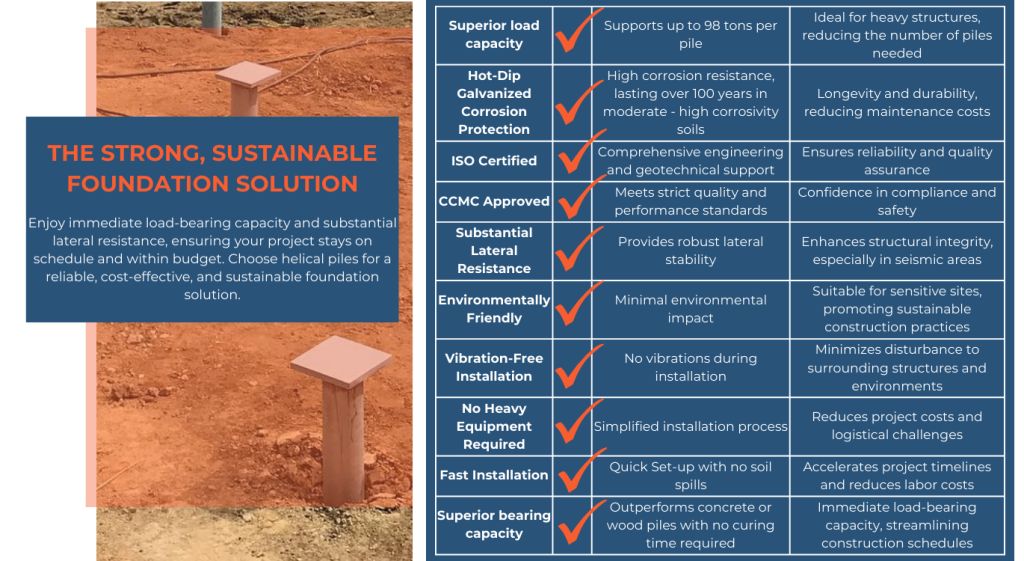
- Faster installation: Helical piles can be installed in a fraction of the time it takes to pour concrete.
- Minimal excavation: Less soil disturbance means a cleaner job site and lower environmental impact.
- No curing time: Unlike concrete, there is no waiting period for piles to settle or cure.
- All-weather installation: Helical piles can be installed in any weather condition, even during winter.
- Cost savings: Helical piles often result in lower labor and material costs compared to traditional foundations.
How long do helical piles last?
Helical piles have a design life of 50 years or more, depending on the soil conditions and the type of project. They are made from galvanized or epoxy-coated steel to protect against corrosion, ensuring long-term durability and reliability.
Do helical piles require any maintenance?
Helical piles are generally maintenance-free once installed. They are designed to resist corrosion and degradation over time, providing a stable foundation for the life of your structure. Regular inspections of the overall foundation and structure may be recommended for certain industrial or commercial projects, but the piles themselves need little attention.
How deep are helical piles installed?
The depth of installation depends on the soil conditions and the load-bearing requirements of your project. On average, helical piles are installed between 10 to 50 feet deep, but they can go even deeper if necessary to reach stable, load-bearing soil.
Can helical piles be used in poor soil conditions?
Yes, helical piles are particularly effective in poor soil conditions such as loose or unstable soils. Because they are screwed deep into the ground until they hit stable soil, they provide a strong foundation even in areas where traditional foundations would struggle.
How quickly can helical piles be installed?
Helical pile installation is significantly faster than traditional foundations. Depending on the project size, a typical residential installation can be completed in as little as one day, while larger commercial or industrial projects may take a few days. There’s no waiting for curing, which means the rest of the construction process can continue almost immediately after installation.
Do I need a permit for helical pile installation?
Yes, most projects will require a permit for the installation of helical piles. At Ontario Helical Piles, we handle the entire permitting process for you, ensuring compliance with all local regulations and codes so you can focus on the rest of your project.
Are helical piles environmentally friendly?
Yes, helical piles are considered an environmentally friendly foundation solution. They require minimal excavation, which reduces disturbance to the surrounding landscape. They also create less waste and have a smaller carbon footprint compared to traditional concrete foundations. Additionally, they are made from 100% recyclable steel.
Can helical piles be removed if needed?
Yes, one of the key advantages of helical piles is that they can be easily removed if the structure needs to be relocated or replaced. This makes them a great choice for temporary structures or projects where future adjustments may be necessary.
What is the load-bearing capacity of helical piles?
Helical piles can support a wide range of loads, depending on the size of the pile and the soil conditions. On average, they can bear up to 500,000 pounds of load, making them suitable for residential, commercial, and industrial applications alike.
How much do helical piles cost?
The cost of helical piles varies depending on the scope of the project, the type of piles needed, and the soil conditions. However, in most cases, helical piles provide 30-40% cost savings over traditional foundation methods due to faster installation times and reduced labor costs. We offer free quotes to give you a clear understanding of your project’s cost.
Can helical piles be installed close to existing structures?
Yes, helical piles can be installed close to existing structures with minimal disturbance. Because installation produces no vibration or loud noise, they are ideal for use in urban areas or near sensitive structures where traditional foundations may cause disruption or damage.
What industries do you serve?
At Ontario Helical Piles, we serve a wide range of industries, including:
- Telecommunications: Tower and antenna foundations
- Residential: Homes, decks, additions
- Commercial: Office buildings, industrial structures
- Energy: Solar, wind, and oil rig installations
- Marine: Docking and waterfront structures
- and more!